

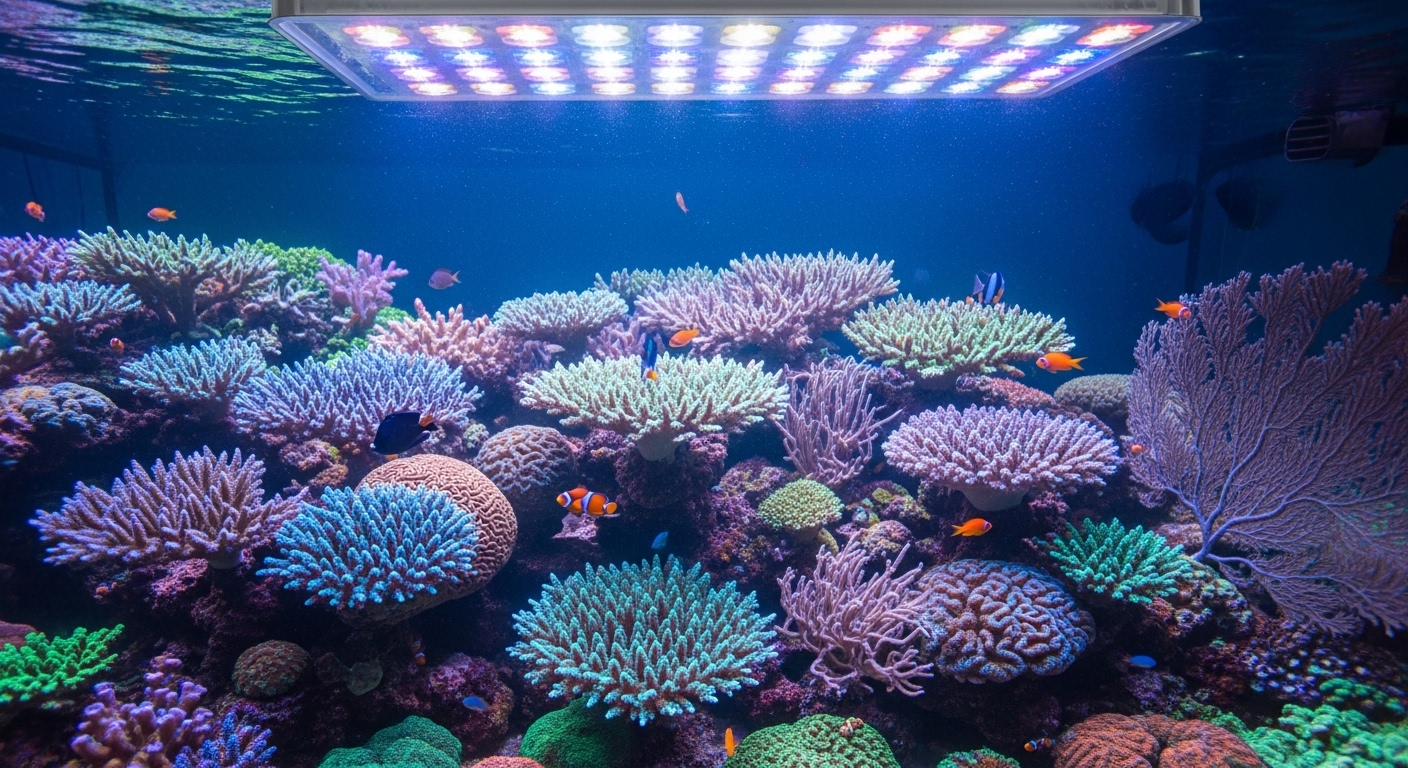
Coral colors don’t fade in a reef tank because the corals are unhealthy. In many cases, they fade because the lighting spectrum is wrong. Many reef keepers assume brighter lights will automatically make corals glow. But coral coloration depends heavily on the correct spectrum, intensity, and lighting schedule. Without the right reef lighting setup, even expensive corals can look dull or brown.
Reef aquariums rely on specialized lighting to replicate sunlight found in tropical oceans. In particular, blue-spectrum reef lighting plays a major role in stimulating coral fluorescence. This process causes corals to glow in neon greens, purples, oranges, and reds under the right conditions.
This guide explains how to use coral color lighting to maximize coral appearance in a reef aquarium. You will learn how reef blue spectrum lights work, why corals fluoresce, what PAR levels influence color, and how to adjust your lighting schedule for better results. Whether you run LED reef lights, T5 systems, or hybrid lighting, understanding these principles will help you bring out the strongest coral coloration in your tank.
What Is Coral Color Lighting and Why Does It Matter?
Coral color lighting refers to reef lighting that emphasizes blue and violet wavelengths to stimulate coral fluorescence and enhance visible pigmentation.
Corals contain fluorescent proteins that react to specific wavelengths of light. These proteins absorb high-energy light, particularly in the blue and near-UV spectrum, and re-emit it as visible colors.
This is why corals appear much brighter under blue reef lighting compared to white lighting.
Key Spectrums That Influence Coral Color
- Violet: 380–420 nm
- Royal Blue: 420–460 nm
- Blue: 460–480 nm
- White: 500–700 nm (supports growth but reduces fluorescence visibility)
Most reef aquarists rely on reef blue spectrum lights because they mimic the wavelengths that penetrate deeper ocean water where many corals naturally grow.
When lighting is tuned correctly, coral pigments such as GFP (green fluorescent protein) and RFP (red fluorescent protein) become highly visible.
Why Corals Change Color Under Lighting
Coral color is influenced by three main factors:
- Light spectrum
- Light intensity (PAR levels)
- Nutrient balance
If lighting lacks blue wavelengths, fluorescent pigments remain hidden. Instead, brown zooxanthellae algae dominate the coral’s appearance.
This is why reef tanks often look more vibrant under actinic or blue lighting compared to daylight settings.
Why Do Corals Fluoresce Under Blue Reef Lighting?
Coral fluorescence occurs when coral proteins absorb blue or UV light and emit longer visible wavelengths such as green, red, or orange.
This natural phenomenon is common in shallow tropical reefs. Scientists believe fluorescence helps corals manage excess light and protect their symbiotic algae from radiation damage.
How Fluorescence Works
The process happens in three steps:
- Blue or UV light hits coral tissue
- Fluorescent proteins absorb this energy
- Light is re-emitted as bright visible colors
Because of this effect, reef tanks with strong blue lighting produce the glowing “pop” many hobbyists want.
Example: Real Reef Tank Observation
A study by Advanced Aquarist Magazine analyzed coral fluorescence under different LED spectrums. Corals exposed to 450 nm blue light showed up to 60–70% higher visible fluorescence compared to broad white light.
Reef keepers often replicate this effect by increasing royal blue channels on programmable LED reef lights.
Which Reef Lighting Spectrum Makes Coral Colors Pop?
The best lighting spectrum for coral coloration combines strong blue (420–470 nm) with moderate white light to balance growth and visual brightness.
Most modern LED reef lights allow independent control of color channels. This makes it easier to adjust the spectrum for coral appearance.
Recommended Spectrum Balance
| Light Channel | Recommended Percentage | Purpose |
|---|---|---|
| Royal Blue | 70–90% | Stimulates coral fluorescence |
| Blue | 60–80% | Enhances coral pigmentation |
| Violet / UV | 20–40% | Triggers fluorescent proteins |
| White | 10–25% | Natural color balance |
| Red / Green | 0–10% | Minimal contribution to coral color |
Too much white light can wash out coral fluorescence, making colors appear dull.
This is why many reef aquariums shift toward a deep blue appearance during peak lighting hours.
How Do PAR Levels Affect Coral Color?
PAR (Photosynthetically Active Radiation) determines how much usable light reaches corals, directly affecting growth and pigmentation.
Corals require specific PAR ranges depending on species.
Typical PAR Requirements
| Coral Type | Recommended PAR |
|---|---|
| Soft Corals | 50–100 |
| LPS Corals | 75–150 |
| SPS Corals | 200–350 |
If PAR is too low, corals may lose vibrant coloration and turn brown due to increased zooxanthellae density.
If PAR is too high, corals may bleach.
Case Study: Reef2Reef Community Data
Reef hobbyists using PAR meters reported that many Acropora corals developed stronger coloration when PAR increased from 180 to around 280 under blue-dominant LED lighting.
The improved intensity helped stimulate pigment production without causing bleaching.
What Lighting Schedule Brings Out Coral Fluorescence?
A reef lighting schedule that includes gradual ramp-up, blue-dominant peak hours, and evening actinic lighting enhances coral fluorescence.
Reef tanks benefit from stable lighting cycles that mimic natural daylight patterns.
Example Reef Lighting Schedule
| Time | Lighting Phase |
|---|---|
| 8:00 AM | Low blue sunrise |
| 10:00 AM | Increase intensity |
| 12:00–5:00 PM | Peak spectrum |
| 6:00 PM | Reduce white light |
| 8:00 PM | Blue actinic viewing |
| 10:00 PM | Lights off |
The evening actinic phase is when coral fluorescence becomes most visible.
Do LED Reef Lights Produce Better Coral Colors?
LED reef lights often produce stronger coral fluorescence because they allow precise control over blue and violet wavelengths.
Older lighting systems like metal halide and fluorescent bulbs offered limited spectrum control.
Modern LED systems provide adjustable channels, making it easier to tune coral color lighting.
Advantages of LED Reef Lighting
- Adjustable spectrum control
- Lower energy consumption
- Less heat generation
- Customizable lighting schedules
- Improved coral fluorescence
Many reef aquarists also combine LED and T5 lighting to balance growth and coloration.
How Long Does It Take for Coral Colors to Improve?
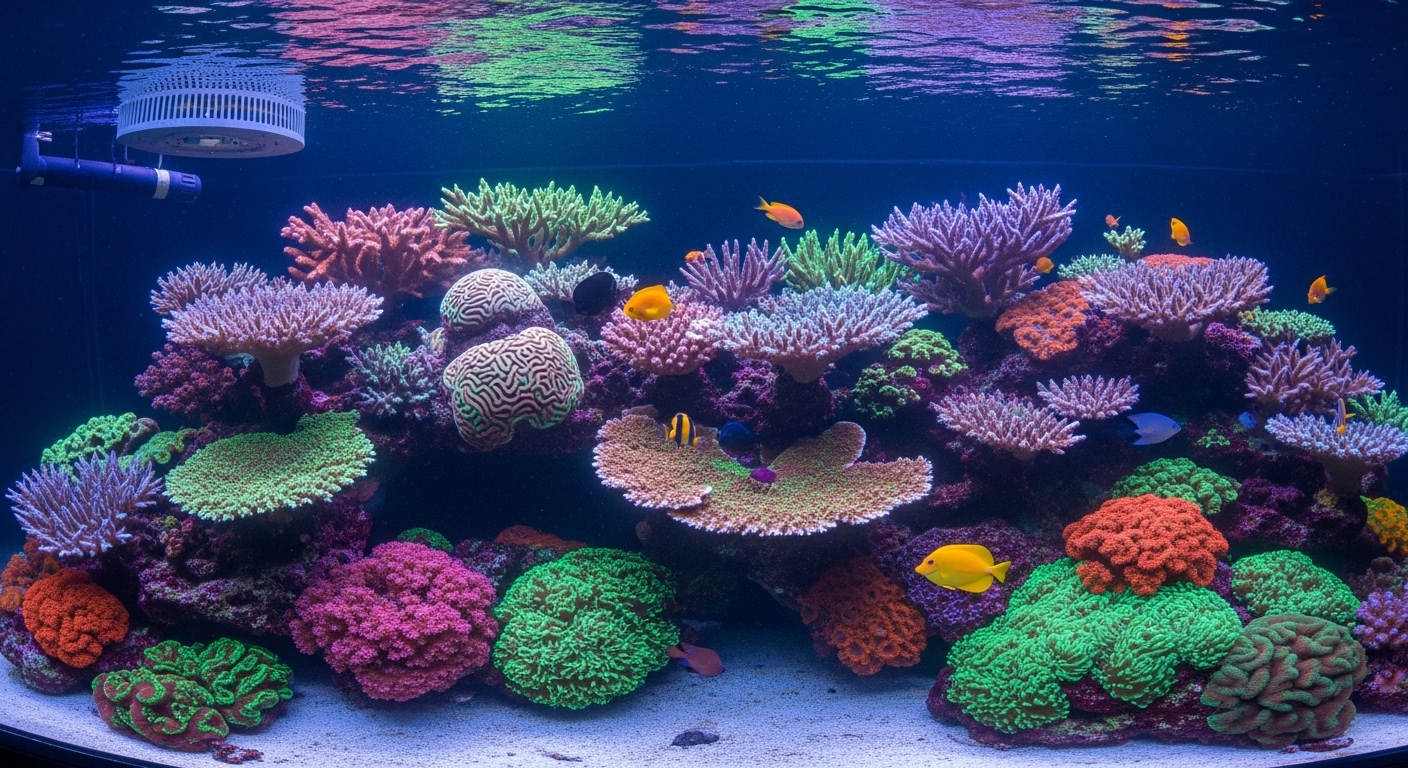
Coral coloration typically improves within 2–6 weeks after adjusting reef lighting spectrum and PAR levels.
However, color changes depend on several factors:
- Nutrient levels
- Water chemistry stability
- Light intensity
- Coral species
SPS corals often show visible color shifts faster than soft corals.
Sudden lighting changes should always be avoided. Gradual adjustments help prevent bleaching.
What Common Lighting Mistakes Reduce Coral Color?
The most common mistake is running too much white light and not enough blue spectrum.
Other Common Problems
- Lighting intensity too low
- Incorrect PAR placement
- Inconsistent lighting schedule
- Rapid spectrum changes
- Cheap lights lacking violet wavelengths
Correcting these issues often restores coral fluorescence quickly.
Conclusion: How to Make Coral Colors Pop With Reef Lighting
Reef lighting is one of the most powerful tools for enhancing coral appearance. When the spectrum, intensity, and schedule are optimized, corals reveal colors that are often hidden under standard aquarium lighting.
The key is focusing on strong reef blue spectrum lights combined with appropriate PAR levels. Blue and violet wavelengths stimulate coral fluorescence, while balanced white light supports healthy coral growth.
Adjusting lighting gradually and maintaining stable tank conditions can dramatically improve coral coloration over time.
If you want to see your reef tank glow with vibrant greens, reds, and purples, start by tuning your lighting spectrum and observing how your corals respond.
Ready to upgrade your reef lighting setup? Experiment with blue-dominant lighting schedules and monitor coral response. With the right coral color lighting strategy, your reef tank can achieve the same vibrant glow seen in professional reef aquariums.
FAQ: Reef Lighting and Coral Color
What color light makes corals glow the most?
Blue light between 420–460 nm produces the strongest coral fluorescence. These wavelengths activate fluorescent proteins inside coral tissue, creating glowing green, red, and orange colors.
Can too much light damage coral colors?
Yes. Excessive PAR levels can cause coral bleaching. When corals receive too much light, they expel symbiotic algae, which removes much of their natural coloration.
Do all corals fluoresce under blue light?
No. Some corals contain stronger fluorescent proteins than others. Species such as Acropora, Zoanthids, and Euphyllia often display the most noticeable fluorescence.
Should reef tanks run blue lights all day?
No. Corals still require a balanced lighting spectrum for healthy growth. Most reef tanks use a mix of blue and white light during peak hours and switch to actinic blue lighting during evening viewing.
How long should reef lights stay on?
Most reef aquariums run lights for 8–10 hours per day. Longer photoperiods can increase algae growth without improving coral health.
Can cheap LED lights grow colorful corals?
Budget LED lights may grow corals but often lack proper spectrum control. Lights with strong royal blue and violet channels typically produce better coral coloration.
Read More Also: How to Pack Surf Gear for a Surf Trip
Find out: Wooden vs Plastic Pasta Drying Rack: Which One Should You Choose?