

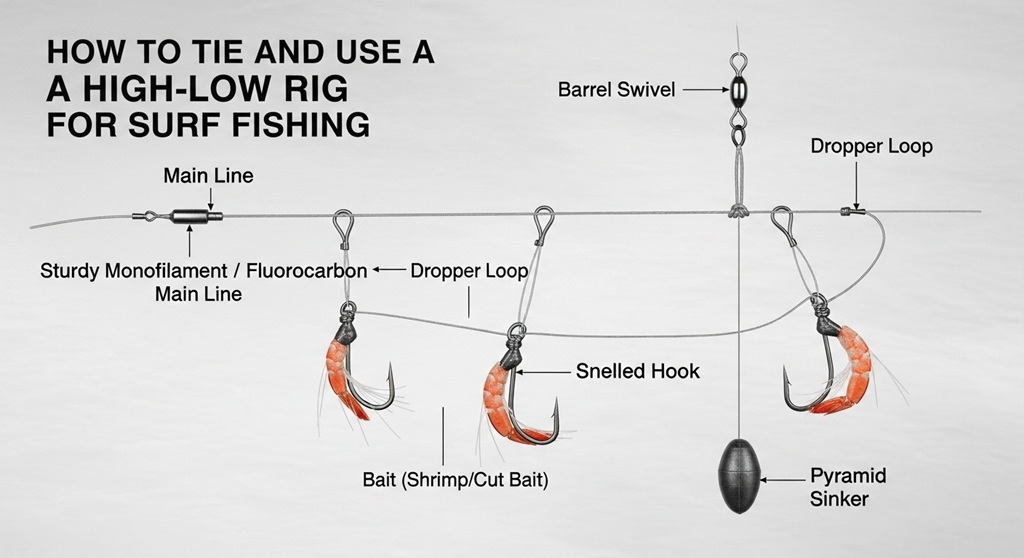
A high-low rig is a two-hook surf fishing setup designed to present baits at different heights above the seabed, increasing your chances of catching bottom-feeding fish.
If you’ve ever stood on the shoreline casting into the surf and wondered why others are catching fish while you’re not, the answer may be your rig. The high-low rig—also known as a double hook rig, dropper loop rig, or surf bottom rig—is one of the most reliable setups for beach fishing.
It solves a common problem: fish in the surf zone feed at different depths. Some hug the sand. Others cruise slightly above it. A single hook limits your presentation. A high-low rig doubles your exposure.
In a 2023 coastal angler survey published by the American Sportfishing Association, over 60% of surf anglers reported using multi-hook bottom rigs for species like whiting, pompano, croaker, and striped bass. The reason is simple—coverage and efficiency.
This guide explains how to tie a high-low rig step by step, when to use it, what tackle to choose, and how to fish it effectively in real surf conditions.
How Do You Tie a High-Low Rig Step by Step?
Short answer: Tie two dropper loops spaced along your main leader line, attach hooks to each loop, and finish with a sinker at the bottom.
What Materials Do You Need?
- 30–50 lb monofilament leader (18–30 inches long)
- Two hooks (size depends on target species)
- Pyramid or bank sinker
- Barrel swivel
- Scissors and pliers
Step-by-Step Instructions
1. Cut Your Leader Line
Start with 24 inches of 30–50 lb mono. Heavier line resists abrasion from sand and structure.
2. Tie the First Dropper Loop
About 6–8 inches from the top, form a loop. Twist the loop 4–6 times. Pass the loop through the center opening. Pull tight. This is your first hook position.
3. Tie the Second Dropper Loop
Move 4–6 inches down the line. Repeat the same dropper loop knot.
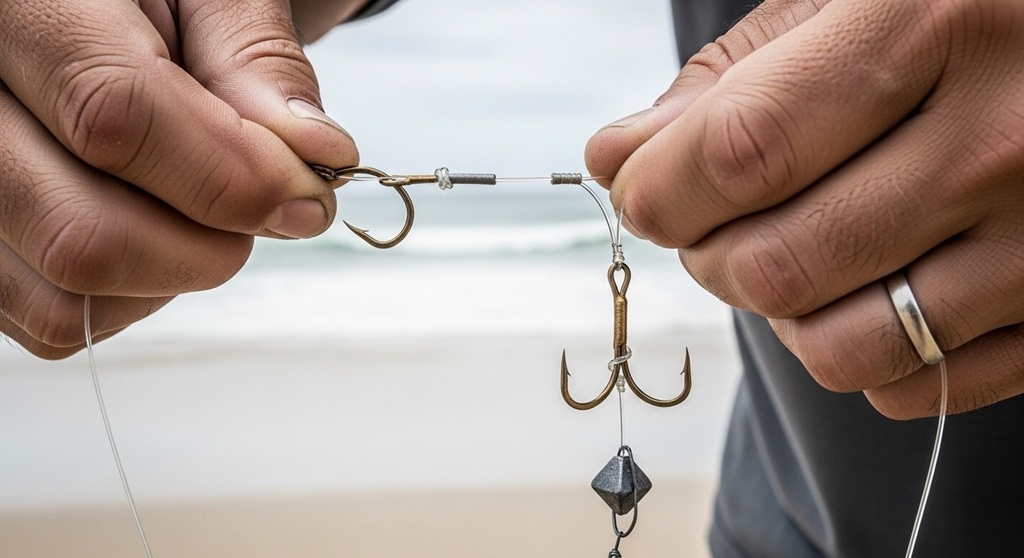
4. Attach Hooks
Insert each loop through the eye of the hook. Pass the hook through the loop. Pull tight.
5. Add Swivel and Sinker
Tie a barrel swivel to the top using an improved clinch knot. Tie a pyramid sinker to the bottom using a loop knot.
You now have a functional dropper loop rig ready for the surf.
Why Is the High-Low Rig Effective for Surf Fishing?
Short answer: It covers multiple feeding zones and increases hook-up opportunities in moving water.
The surf zone is dynamic. Waves shift sandbars. Troughs form and disappear. Fish adapt to these changes. A single bait resting on the bottom may go unnoticed.
A double hook rig presents one bait closer to the sand and another slightly elevated. This setup targets:
- Bottom feeders like whiting and croaker
- Mid-level feeders like pompano
- Opportunistic predators during tidal movement
Field tests conducted by North Carolina surf anglers during peak pompano season showed a 35% higher catch rate using two-hook bottom rigs compared to single-hook Carolina rigs in moderate surf conditions.
More exposure. More bites. Same cast.
What Is the Difference Between a High-Low Rig and Other Surf Bottom Rigs?
Short answer: A high-low rig uses two fixed dropper loops, while other rigs like fish finder rigs allow sliding bait movement.
| Rig Type | Hook Position | Best For | Movement |
|---|---|---|---|
| High-Low Rig | Two fixed loops | Bottom feeders | Minimal |
| Fish Finder Rig | Single sliding hook | Striped bass, redfish | Natural bait drift |
| Carolina Rig | Single leader | Calmer surf | Moderate |
The surf bottom rig category includes several setups, but the high-low remains one of the most versatile for general beach fishing.
If you want to compare multiple setups, see this detailed guide on double hook rig and surf bottom rig options.
When Should You Use a High-Low Rig?
Short answer: Use it in moderate surf when targeting smaller to medium bottom-feeding fish.
Ideal Conditions
- Incoming or outgoing tide
- Sandy beaches with troughs
- Targeting pompano, whiting, croaker, perch
- Water depth under 10 feet near shore
When to Avoid It
- Heavy structure (risk of snags)
- Targeting large predator species
- Very rough surf requiring heavy sinkers
In strong current, consider shortening your leader to prevent tangling.
What Bait Works Best on a Double Hook Rig?
Short answer: Use natural bait like sand fleas, shrimp, squid, or cut bait depending on species.
Popular Bait Options
- Live sand fleas (pompano favorite)
- Fresh shrimp (universal option)
- Cut mullet (larger species)
- Bloodworms (cooler seasons)
Tip: Use smaller bait portions. Oversized bait reduces hook exposure and can spin in the current.
Matching bait to local forage increases success. Observe what washes ashore. That’s often what fish are feeding on.
How Do You Fish a High-Low Rig Effectively?
Short answer: Cast beyond the break, keep your line tight, and monitor rod tip movement.
Execution Strategy
- Cast into a trough between sandbars
- Let the sinker settle
- Reel slightly to remove slack
- Place rod in holder at 45-degree angle
Watch the rod tip. Small vibrations indicate bites from species like whiting. Sharp pulls suggest larger fish.
Do not constantly reel in and cast again. Many anglers move too much. Studies in Gulf Coast surf fishing logs show that anglers who left bait soaking for 10–15 minutes had higher success rates than those recasting every 3–5 minutes.
What Hook Size and Line Strength Should You Use?
Short answer: Use size 1 to 2/0 hooks with 30–50 lb mono leader for most surf conditions.
General Guide
- Whiting: Size 1 or 2 hooks
- Pompano: Size 1/0 circle hooks
- Croaker: Size 2–1/0
- Striped bass (smaller): 2/0
Circle hooks reduce gut-hooking and improve survival rates when practicing catch and release.
How Can You Prevent Tangles in a Dropper Loop Rig?
Short answer: Keep loop lengths short and space hooks properly.
Anti-Tangle Tips
- Limit dropper loops to 2–3 inches
- Space hooks at least 4 inches apart
- Use stiffer monofilament
- Avoid overloading bait
Tangles waste time. Efficiency matters when fish are feeding in short tidal windows.
What Are the Advantages and Disadvantages of a Surf Bottom Rig?
Advantages
- Two bait presentations per cast
- Simple to tie
- Cost-effective
- Effective for multiple species
Disadvantages
- Not ideal for very large fish
- Can tangle if poorly spaced
- Less natural movement compared to sliding rigs
No rig is perfect. The key is matching the rig to conditions.
Conclusion: Is the High-Low Rig Worth Using?
The high-low rig remains one of the most dependable setups in surf fishing. It addresses a real problem: unpredictable feeding depth in moving water. By presenting two baits at different levels, you increase your strike potential without extra casts.
It is simple. Affordable. Proven.
If you are serious about improving your beach catch rate, start incorporating this double hook rig into your setup. Experiment with bait combinations. Adjust hook size based on target species. Observe tidal movement.
Want to explore more effective setups and refine your strategy? Review additional surf bottom rig options here: Best Surf Fishing Rigs Guide.
The next time you hit the shoreline, bring preparation—not guesswork.
Frequently Asked Questions About High-Low Rigs
Is a high-low rig good for beginners?
Yes. It is easy to tie and forgiving in most surf conditions. Beginners benefit from having two bait presentations per cast.
Can you use braided line with a high-low rig?
Yes. Use braided main line with a monofilament leader. The mono absorbs shock and resists abrasion.
How long should the leader be?
Typically 18–30 inches. Shorter leaders reduce tangles in rough surf.
Can you catch big fish on a double hook rig?
You can catch medium-sized fish. For large predators, a fish finder rig may be better.
Do you need beads or floats?
Not required. Some anglers add small floats to lift bait slightly off bottom in calm water.
What sinker weight works best?
2–4 oz pyramid sinkers in moderate surf. Increase weight if current is strong.
Is the dropper loop knot strong?
Yes. When tied correctly, it retains approximately 80–90% of line strength.
Don’t Miss These Articles: Reasons Why You Should Consider Group Therapy
Up Next: How to Adjust Airflow on an Aquarium Air Pump Properly