

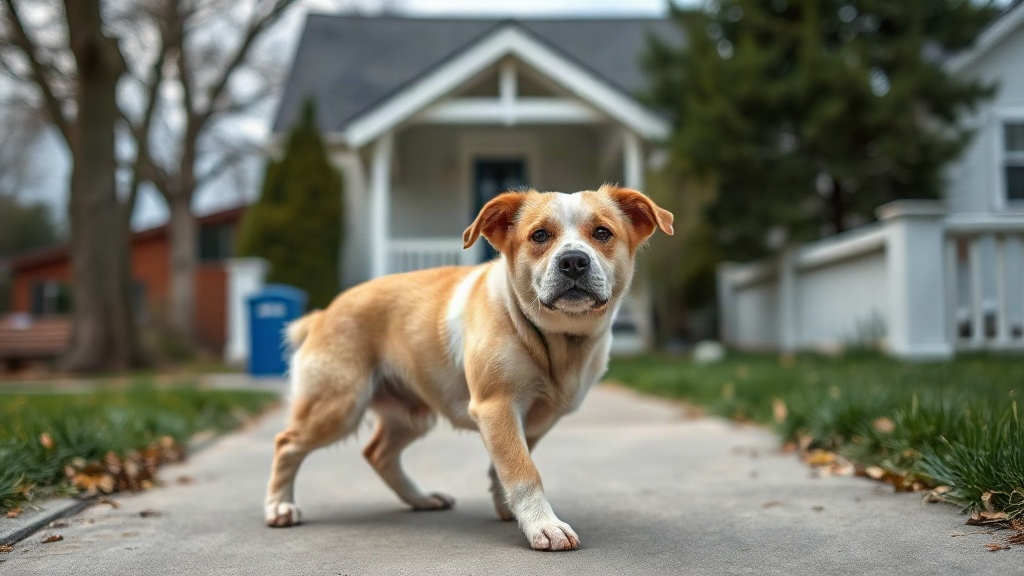
Your dog plants his paws two doors from the corner house and simply stops. The leash goes taut, his tail tucks, and no amount of cheerful coaxing moves him forward. If you have wondered why my dog refuses to walk past a certain house on the street, you are not alone—this is one of the most common walking puzzles owners report.
Quick answer: A dog usually refuses one specific house because something there triggers fear, overexcitement, or a strong scent memory. Common culprits are a barking resident dog behind a fence, a strange noise, a slick or hot surface, or a scary event that happened there once. The fix is to identify the trigger, then rebuild calm associations at a distance before walking closer.
This article explains what is happening in your dog’s mind, how to read the signals he gives, and it offers a practical plan for getting past that house without a daily battle.
Definition and background
A “refusal point” is a spot on a familiar route where a dog consistently stops, pulls back, freezes, or tries to turn around. The behavior is specific to that location, not to walking in general. That specificity matters, because it tells you the dog is reacting to something at that house rather than to the leash, the weather, or fatigue—though it is worth ruling those out too.
Dogs experience the world primarily through smell and hearing. A study published in Science in 2004 suggested dogs may have the olfactory capacity to detect some odors at concentrations in the parts-per-trillion range—far beyond human sensitivity. Put simply, the front of a strange house may hold information a human nose cannot detect: another dog’s urine, cleaning chemicals, pest control products, or food smells drifting from a kitchen.
Dogs also generalize by location. If something frightening happened near one address—a garbage truck backfired, a loose dog charged, a metal grate clanged—the dog may link that address with danger. Behaviorists call this single-event learning, and it can stick after just one exposure.
Fear is not the only explanation. Some dogs stop because the house hosts a dog that fence-fights with them through the barrier. Others freeze because the pavement there is scorching or salted in winter. A few simply want to greet a resident they know. The stopping looks identical from the leash end; the cause underneath is not.
Territorial behavior matters too. A dog walking past another dog’s home may sense that it is crossing an invisible property line. Confident dogs may try to mark it; anxious dogs may avoid it altogether. Either way, the house becomes a fixed point of emotional significance.
One more layer is age and health. A senior dog may balk at a driveway ramp or a change in ground texture. Pain, reduced vision, or hearing loss can make a familiar route feel new and threatening. Rule out discomfort with your veterinarian before assuming the problem is purely behavioral.
How why my dog refuses to walk past a certain house on the street works
The mechanics follow a simple sequence. Your dog notices something at the house—sound, scent, motion, or a change in footing. His body reacts before his brain has consciously classified the threat. Stress hormones such as adrenaline and cortisol rise, preparing a fight-or-flight response.
That is when you see the visible signs: a sudden stop, lip licking, yawning, ears pinned back, tail lowered, weight shifted backward, or a hard stare. These are what trainers call distance-increasing signals—the dog is asking for space. If those signals succeed, the behavior is rewarded. Next time, he stops sooner and harder.
Walking the same route every day reinforces the pattern. Each pass adds another rehearsal of “this house is scary, and stopping works.” The habit strengthens through repetition, not through the house itself being dangerous.
A useful analogy is a person who once got chased by a wasp near a particular bench. The bench is not the problem; the memory attached to it is. Dogs work the same way, except their memories are often anchored to smell and sound rather than sight. This is why a house can look completely ordinary to you and feel entirely different to your dog.
Your own reaction feeds the loop. A tight leash signals tension to your dog. A rushed, frustrated tug can be read as confirmation that something is wrong. Owners who brace or shorten the leash the moment they approach the house unknowingly prime the response.
The good news is that the same learning machinery runs in reverse. If the house starts predicting something pleasant—treats, a relaxed pace, a familiar cue—the emotional charge gradually fades. This process is called counterconditioning, and it works best when the dog is still calm enough to eat and think.
Watch the 5 to 10 meters before the house, not the moment of refusal. The first sign of tension—a head turn, a pause, a shifted weight—shows your dog’s warning threshold, and that spot is where training should begin.
Real-world examples
The invisible fence barker. One owner’s dog stopped beside a house where a small terrier charged the window when the doorbell rang. The dog on the leash heard the muffled bark and froze. Solution: walk the route on the quiet side of the street while tossing a treat each time a bark sounded. After about three weeks of daily passes, the dog could walk near the window with a loose leash.
The memory anchor. A rescue dog refused a corner house for months. The owner eventually realized a metal storm grate in front of the door rattled when cars passed. The dog had been startled by it once. Placing a treat on the grate step by step, over roughly eight sessions, removed the fear. The dog now walks over the grate without a pause.
The fence fighter. A young shepherd mix lunged and barked at the same beagle every morning through a low hedge. This is not fear but frustration and territorial arousal. The owner changed the walk time by 20 minutes to avoid the beagle, then practiced walking past a different dog at a calm distance to teach appropriate behavior on a leash.
The surface avoider. A senior cocker spaniel stopped in front of a house where the pavement was repaired with a raised lip. The owner thought it was behavioral until the vet found early arthritis. Shifting to a nearby block removed the problem entirely. This illustrates why a vet check belongs early in the process.
The greeting stopper. One Labrador planted himself outside a particular house because the owner there handed out dog biscuits daily. The dog was not anxious—he was waiting for his snack. A quick conversation with the neighbor ended the routine, and the stopping ceased within days.
The heat check. On hot days, a black-coated dog refused to cross a section of dark asphalt in front of a house that got full afternoon sun. The owner began walking that block in the early morning. Problem solved, and a real burn risk avoided.
Comparison: fear-based vs. excited stopping
Both stops look stubborn from the leash, but the dog’s body language and the fix differ sharply.
| Signal | Fear-based | Excited or frustrated |
|---|---|---|
| Body posture | Low, weight back, tail tucked | Forward, high tail, wiggling |
| Eyes and ears | Wide eyes, ears back | Focused stare, ears forward |
| Voice | Silent or whining | Barking or whining loudly |
| Reaction to food | Refuses treats | Eats but stays alert |
| Effective fix | Build distance and calm | Teach an alternative behavior |
If your dog refuses food at the spot, that is a strong clue the emotion is fear and the training should start farther away. A dog that snaps up treats but still pulls is likely excited and needs management rather than reassurance.
Common misconceptions
“He does it on purpose to annoy me.” Dogs do not plan spite. The refusal is a stress response or a learned habit, and viewing it as defiance makes owners tug harder, which worsens it.
“Just pull him past it and he’ll get over it.” Flooding—forcing a frightened dog through the trigger—often deepens the fear. A dog dragged past a scary house learns that the leash does not help him.
“He’ll grow out of it.” Some do, but many do not. Repeated rehearsal of the stopping behavior usually entrenches it rather than resolving it.
“It must be a ghost or something weird.” Dogs detect smells, sounds, and vibrations humans miss, so the house may genuinely hold something you cannot perceive. The trigger is still real and measurable, even if it is invisible to you.
“It’s always fear.” As the examples above show, excitement, territorial arousal, surface discomfort, and even a friendly neighbor with treats can produce the same stop. Mislabeling the cause sends you down the wrong training path.
“Treats spoil the dog.” Rewarding a calm pass past a trigger teaches the right behavior. It is not bribery; it is changing what the house predicts.
“Only walking lessons help.” Some cases need a veterinarian, a behaviorist, or a phone call to the neighbor. The daily walk is where you practice, not always where you solve.
FAQ
Why does my dog only stop at one specific house and not others?
The house is probably tied to one distinct stimulus: a resident dog, a machine noise, a scent, or a surface change. Dogs form location-specific memories, and that spot has become the anchor. Note what you see and hear at the same time of day to pinpoint it.
Should I avoid the house entirely and change my route?
Short term, avoiding the trigger prevents repeated stress. Long term, you want the dog to learn the house is safe. Build a calm-distance practice plan, then reintroduce the spot gradually while using a quiet alternate route in between.
How long does it usually take to fix?
With consistent daily practice, many dogs improve noticeably in two to four weeks. Long-standing fears can take several months. Progress is measured by a looser leash and softer body language, not by a single good pass.
Will getting frustrated with my dog make it worse?
Yes. Raised voice, tight leash, and pulling all read as danger and confirm the dog’s alarm. Keep your body relaxed and your pace steady, even if you turn back for the day.
When should I see a vet or behaviorist?
Book a vet visit if the refusal appeared suddenly, if the dog is older, or if you suspect pain or vision loss. Seek a qualified behaviorist if your dog panics, tries to bolt into traffic, or shows no improvement after several weeks.
Conclusion
A single-house refusal almost always traces back to a specific trigger, a learned habit, and a daily rehearsal that reinforces both. Your job is to read the body language early, rule out pain, and rebuild calm associations at a comfortable distance before you expect a clean pass. Progress comes in small steps, and treats given at the right moment do real work.
Start this week: note the exact spot where your dog first tenses, then practice a calm pass from several meters away with high-value treats.